PandaText / Articles / PandaText or React Native Enriched HTML?
PandaText or React Native Enriched HTML?
React Native Enriched HTML is Software Mansion's rich text editor for React Native. I make PandaText, which does the same job in a different way, so I'm not neutral here.
Both run as native views on iOS and Android. For this page I read the documentation of React Native Enriched HTML 1.2 on 24 November 2026. The pages I used are listed at the end.
What they share
You need React Native's New Architecture for either React Native Enriched HTML or PandaText, and both work in Expo development builds. Version 1.2 of theirs supports React Native 0.82 through 0.88. PandaText needs 0.82 or later.
The everyday formatting is the same too: bold, italic, underline, strikethrough, text color, highlight, font size and lists. You call methods on a ref to apply it, and people type with their own keyboard.
Where the lines break
React Native Enriched HTML leaves the text to the platform on iOS and Android, and uses Tiptap on the web. Its compatibility page is open about what that means: "Android, iOS and Web are built on different text systems, so a few APIs behave differently depending on the platform." If you justify a paragraph, for example, Android shows it with its natural alignment.
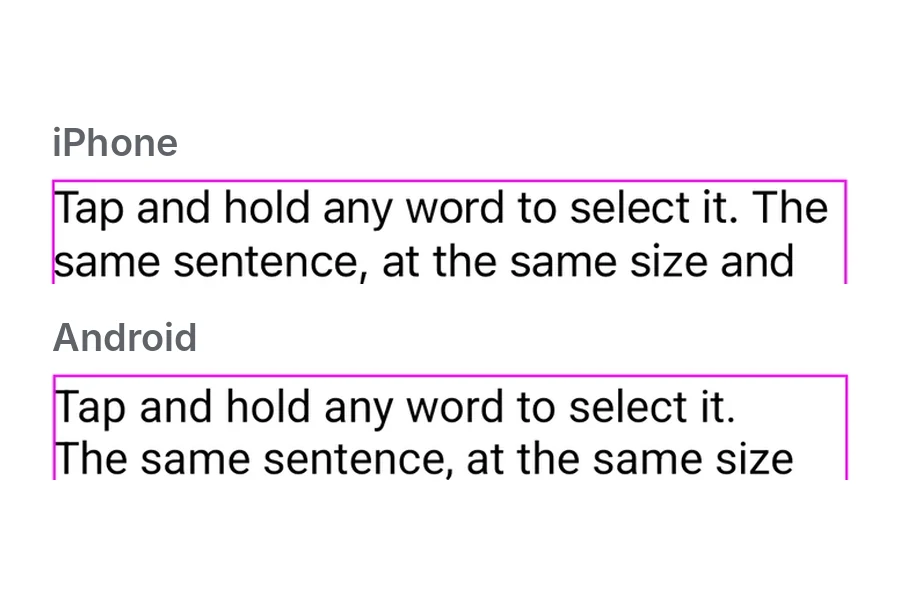
It also means three systems decide where a line ends, and they can decide differently for the same note. In a chat nobody will notice. You notice once somebody has drawn a circle around a word and it lands on another word on the other phone.
PandaText breaks lines with one engine on iOS, Android and the web. Give it the same font files and the same width, and each line ends on the same word.
What your app stores
With React Native Enriched HTML you store HTML. You pass in a string and read a string back, which is handy if your server keeps HTML already. The editor knows a fixed set of tags, including headings, links, mentions and inline images, and it removes or converts the rest. On the phones, sanitizing the HTML is up to you.
With PandaText you store the text and style runs, which say that this range is bold and that one is red. A comment can be saved as a start and an end in the text.
Which apps can use it
If everything you ship is React Native, theirs is convenient: you import one component, and its core props, methods and events are the same on iOS, Android and the web.
PandaText has a React Native package for the phones and a separate web package. It also has packages for Swift, Kotlin and Flutter, so the Mac app you write in Swift opens the same text with the same lines.
If your users write Arabic or Hebrew, PandaText puts it on the same line as English today. React Native Enriched HTML has right-to-left text on its roadmap, together with nested lists and screen reader support.
A document viewer and editor on several platforms
If I had to show and edit the same document on iOS, macOS, Android and the web, I wouldn't build it with anything else. Somebody highlights a sentence on a laptop, somebody else opens it on a phone, and with the same fonts and width the lines match and the highlight sits on the same words.
The viewer and the editor are one view. Make it read-only and people can still select and copy. Make it editable and they type as they do in any other app, while the lines keep breaking on the same words. Paragraphs are laid out as they scroll into view, so a long document doesn't have to be laid out before it opens. Arabic and Chinese and Japanese break the same way on each platform as well.
React Native Enriched HTML splits this into EnrichedTextInput for editing and EnrichedText for showing the result, which its docs suggest for a chat message, a comment or an article. The lines in both come from the platform.
License
React Native Enriched HTML is free, and the MIT license lets you read the code and change it.
PandaText is commercially licensed. You can use it freely in development. Production use requires a license key.
Which one to choose
For messages, comments and posts with mentions, I'd start with React Native Enriched HTML. The same goes if your content is HTML, or if you want something free under MIT.
For documents that people read and edit on several platforms, use PandaText. It's also the one for long or mixed-script text, and for anything attached to a word that has to stay there.
How PandaText handles this
The React Native component wraps the native iOS and Android views, and those use the same engine as the web package. The React Native docs have the install steps, and the feature list shows what the editor can do.
Choose an editor
- Look at what you store. If your server is full of HTML, React Native Enriched HTML will read it as it is. If you keep text and ranges, PandaText is closer.
- Count your apps. Include the ones that aren't React Native, such as a Mac app.
- Compare the lines. Put one long paragraph on an iPhone, an Android phone and in a browser, with the same font and width. Would a different line break anything in your app?
- Try a real document. Open one of yours, edit it on a phone, save it, and look for changes you didn't make.
Questions
Is React Native Enriched HTML the same as react-native-enriched?
Yes, it was renamed. The package is now react-native-enriched-html.
Does React Native Enriched HTML work on the web?
Yes. On the web it uses Tiptap, behind the same core API as on the phones.
Can one app use both?
Yes. They are separate components, so you could use React Native Enriched HTML for messages and PandaText for documents.
Sources
- React Native Enriched HTML: getting started
- React Native Enriched HTML: compatibility
- React Native Enriched HTML: web support
- React Native Enriched HTML: core concepts
- React Native Enriched HTML: HTML format and supported tags
- React Native Enriched HTML: rendering rich text
- React Native Enriched HTML: roadmap
- React Native Enriched HTML: license
Related articles
We use Tiptap on the web. What do we use for iOS and Android?
Your web editor is Tiptap and you need iOS and Android. Tiptap in a WebView, a native editor per platform, or one editor everywhere.
Why the same text wraps differently on iOS and Android
One sentence on an iPhone and an Android phone, same size and width. The system font, emoji and line height each changed the result.